JUSTINE TE
"Improve constantly and forever the system of production and service, to improve quality and productivity, and thus constantly decrease costs."
- W. Edwards Deming
P R O J E C T 1 - Lighting and Acoustic Performance Evaluation and Design
In this project, students are to form a group of 6 students per group to evaluate their environment in terms of lighting and acoustics performances. Each group is required to choose a case study from the list of buildings provided. Then, prepare a measured drawing with appropriate scale of the case study. Show all the necessary features which effect on the lighting and acoustics conditions of their case study. Besides that, students should also carry out an appraisal of day-lighting, artificial lighting, noise and sound condition (quality and quantity) in the selected case study. Their identification of adequacy of the quantity of light and sound / noise for the case study needed to be carried out objectively. In order to carry out this project, each group are given a lux-meter and sound level meter.
W A N A K A T H E B U N G A L O W.
In a group of seven, we have chosen the Wanaka Bungalow as our site of study. We visited the place several times in order to collect all the necessary data, which include measured drawings of the plan, measurement of lighting and acoustics. Located in Damansara Heights, Kuala Lumpur, the Wanaka was once a bungalow residence, which was then converted into an office. On some occasions, the house is used to hold small events and functions such as wedding receptions. This makes the building more interesting to study as we get to understand the lighting and acoustic in a space used for different functions. Besides that, we chose this building as a place to conduct our studies because of location that is strategic, and has a lot of potential in terms of our studies. It’s located right beside the road, which is interesting because then the acoustics would play an important role in this house as well as the light penetration within the building. We wanted to study how much the noise from the road affected the acoustic and noise in the building. There are many opening as well in the building which allow light to light the place. There is even an oculus at one part of the building which allow a lot of natural daylighting to the space. Materials installed interiorly create an ambiance, which differs each room’s ambiance and creates different kinds of usage for each room. However, since it was originally designed as a residential space rather than an office space which is what it is used as today, the lighting and acoustic standards might not be met or might be too high compared to the standards. Therefore, we have decided that this building was very suitable to conduct our lighting and acoustic studies.
In conclusion, I am able to produce a complete documentation on analysis of space in relation to lighting requirement such as natural and artificial lighting and analysis of factors which effects the lighting design of a space. Besides that, I learned to explore and apply understanding of building physic like lighting towards building or construction technology and building materials on existing building projects. This project also teaches me to evaluate and explore the improvisation by using current material and technology in relevance to present construction industry. Basic understanding and analysis of lighting layout and arrangements by using certain methods or calculations such as lumen method and PSALI. However, reverberation time and sound transmission coefficient calculation is used for analyse the acoustics design layout and arrangements.
O V E R A L L
This subject improves my understanding towards the application of building science as a tool to maintain human comfort whilst reducing the environmental impact of construction, with emphasis on energy efficiency and energy saving by integrating day lighting into lighting design (PSALI). Upon successful completion of this subject, I am able to recognize the relevance of design implications on the acoustic and lighting environments. I am also able to explain the terminologies used in architectural acoustics and lighting. Besides that, I have learned to describe design of spaces free from glare, lit with proper selection of light sources, including day lighting strategies that can be applied to designs to create more sustainable designs. Other than that, I also gained my skills in calculating the required amounts of external opening required to provide adequate internal illumination levels for simple designs and apply knowledge to creatively introduce daylight into interior spaces without bringing in heat. Another skill that i have gained is to design simple acoustically-compatible spaces that able to enhance sound qualities in spaces while exploring noise reduction method to achieve required reverberation time.
P R O J E C T 2 - Integration
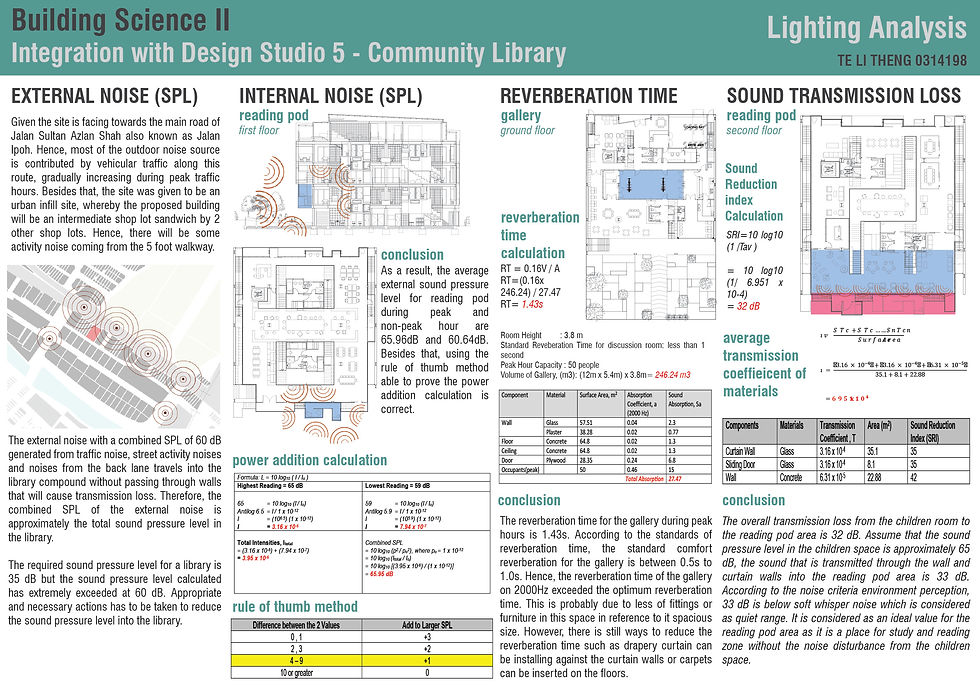
This project aims to integrate my understanding of the principles of lighting and acoustics in the context of my final design project of studio 5. It encompasses advanced daylighting systems and the integration of electrical lighting, strategies for noise management and room acoustics. In project 2, I was required to incorporate one A2 board for lighting integrated design and 1 A2 board for acoustics integrated design and to be submitted in a clear folder. Within student's building design, students are reuired to identify spaces which require artificial lighting and day-lighting. As for the acoustic, students are required to identify spaces to integrate their external noises and internal noises. Integration must be solutions and must be attached in A4 and submitted together.
T H E P O D S L I B R A R Y.
As part of the Design Studio 5 integrated module, this project is to focus on the principles of lighting and acoustics in the context of the overall design proposal. With a given urban infill site in Jalan Azlan Shah (Jalan Ipoh), Sentul, whereby the proposed building will be an intermediate shop lot, sandwich by 2 other shop lots.
The new proposed building is going to be a Community Library with some budget accommodations. The biggest challenge of the site is to how to bring more natural lighting into the interior spaces since there are only front & rear facades and roof to have contact with the exterior. Besides the lighting challenge, the noise of the heavy traffic in front of the site also another issue need to be tackled.
Besides that, all the lighting and acoustic system in the building needs to be able to solve the design problems in relation to sustainability issues. When the Community Library is design for human centric, it need to provide the best thermal comfort at the same time not costly, and a quiet place to catch a reading and run some community meetings. Eventually it will be a vibrant and interesting place for the communities, welcoming individuals of all ages and all foundations. It will be a centre for an assortment of social, learning and recreational opportunities. Therefore, there are a few spaces were chosen for lighting and acoustic system. As for the lighting system I have chosen The Gallery, Computer Lab, Lobby, Entrance Hall and Cafeteria. Spaces chosen for acoustic system are Reading Pod, Office, Gallery, Entrance Hall, Children Space and Bedroom. These spaces were chosen to analyse the spaces in relation to lighting and acoustic requirement then analyse the factors which effects the lighting and acoustic design of the spaces.
Throughout this project, I have learned to produce site analysis which document, interpret and analyse the site context in relation to lighting and acoustics. Besides that, I also learned to solve design problems in relation to sustainability issues such as natural lighting, site analysis, noise control and etc. This project teaches me to design spaces incorporating appropriate lighting and acoustic systems through some of the the method such as lumen method and PSALI.


F L O O R P L A N S & S E C T I O N S


W A N A K A T H E B U N G A L O W


A R T I F I C I A L L I G H T I N G

I N T E G R A T I O N B O A R D S
© 2014 by JUSTINE TE. All Right Reserved.
Bachelor of Science (Hons) in Architecture
Taylor's University Lakeside Campus

